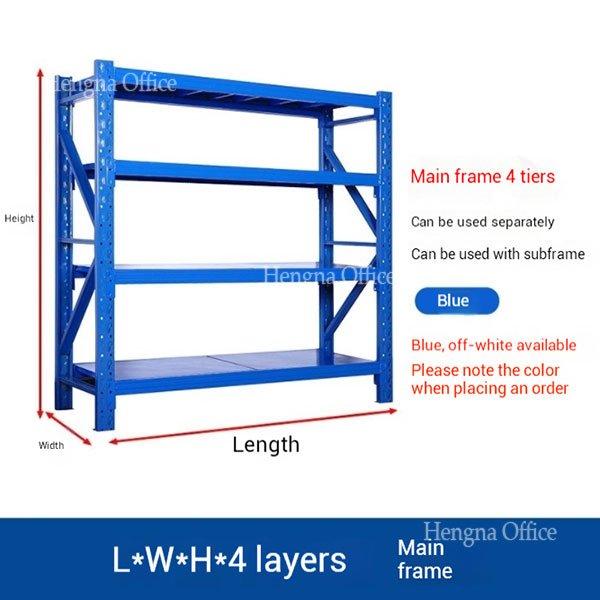
What’s the worst thing that can happen to lab shelving? Not rust — contamination.
Chemicals spill. Solvents drip. Powders settle. On a painted cold-rolled steel rack, the coating blisters, flakes off, and drops particles onto samples below. On a bolted rack, residue hides in screw threads and crevices where cleaning can’t reach.
A 304 stainless steel lab rack isn’t about preventing rust on the metal. It’s about preventing the rack itself from becoming a contamination source.
Material — Where 304 vs 201 Splits in a Lab
Labs are not uniform. Some contain nothing but dry instruments. Others handle concentrated acids daily. The material choice should follow the zone:
| Lab Area | Recommended Grade | Why |
|---|---|---|
| Sample storage room (dry, ambient) | 201 | No chemical exposure risk |
| Chemical / reagent storage | 304 | Common acids and solvents — 304 resists chemical attack |
| Biology lab / cleanroom | 304 | GMP requires easy-to-sanitize, particle-free surfaces |
| Analytical instrument room (HPLC, GC, MS) | 304 | Instruments are sensitive to airborne particles |
| Pathology / dissection lab | 304 | Frequent disinfectant wipes — surface must not react |
| Teaching / student lab | 201 | Lower chemical concentration, cost-effective option |
The difference between lab and other environments:
- Kitchen: 304 resists grease and steam
- Cold room: 304 resists condensation cycles
- Lab: 304 resists chemical corrosion AND microbial load
That second part — microbial load — is what sets lab shelving apart from kitchen or cold room use.
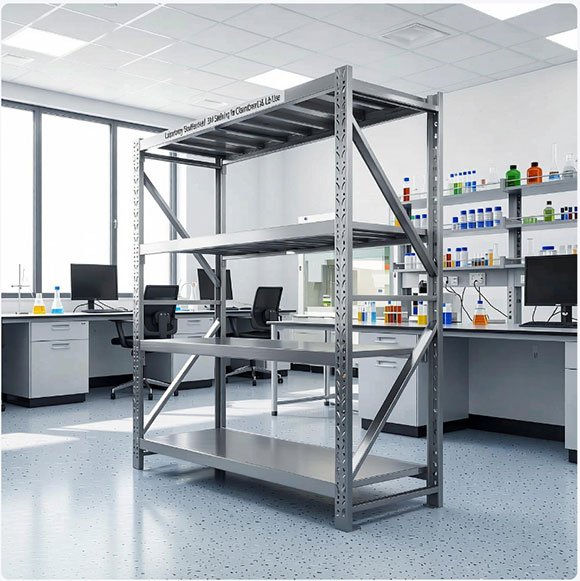
Why Adjustable Shelves Matter More in a Lab
Lab equipment varies wildly in height — 10cm beakers, 30cm reagent bottles, 60cm analyzers. Fixed shelves waste space or can’t fit the equipment.
| Equipment | Typical Height | Shelf Spacing Needed |
|---|---|---|
| Beakers, graduated cylinders | 10-20cm | ~25cm |
| Reagent bottles, standard solutions | 30-40cm | ~45cm |
| Small centrifuge, incubator | 50-70cm | ~80cm |
| Large bench-top analyzers | 80+cm | Up to 120cm |
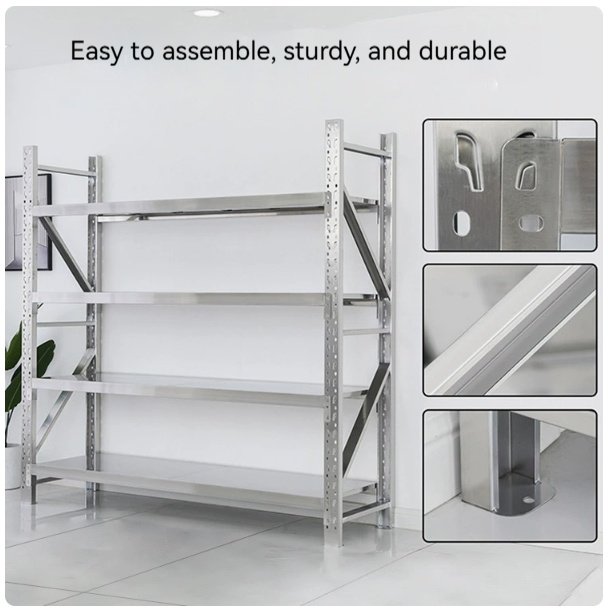
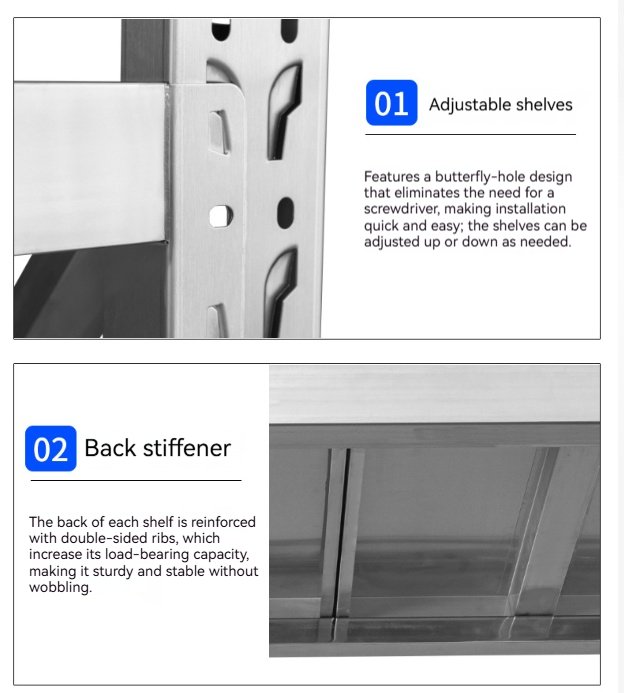
Butterfly snap connectors allow 50mm height adjustment increments. Lift and re-snap — no tools. A 4-tier rack can be configured at 20/30/60/80cm spacing to fit different equipment. When the lab layout changes, reconfiguring takes 10 minutes.
Why Boltless in a Lab?
| Factor | Bolted Shelving | Butterfly Snap (Boltless) |
|---|---|---|
| Particle trap | Screw threads collect particles | No through-holes, smooth surface |
| Cleanability | Crevices trap residue | Wipes clean in one pass |
| Disinfectant | Residue pools in gaps, dries slowly | Surface exposed, dries fast |
| GMP audit | Raised as an issue | Easy to defend — “surface complete, easy to clean” |
The higher the cleanroom class, the more surface integrity matters. Every beam and shelf panel on a boltless rack is a single formed piece — no holes, no threads, no hidden crevices where cleaning misses.
Build Details — Lab-Specific
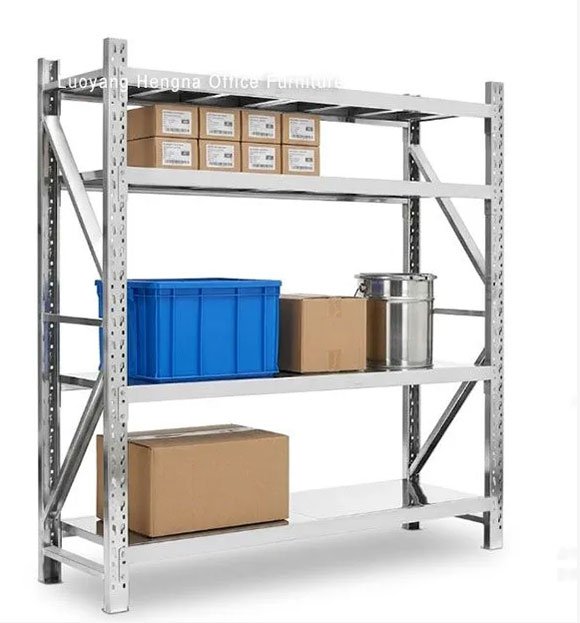
Triangular bracing: Lab racks typically aren’t fastened to walls or floors. Diagonal braces between column pairs prevent lateral sway when samples are accessed frequently.
Double-reinforced shelves: Lab glassware breaks under shelf sag. Double ribbing underneath keeps shelves level and prevents deflection under sustained load.
Surface treatment:
- Rounded edges on all corners — no sharp edges when handling glassware without gloves
- Brushed finish — resists fingerprints and shows fewer scratches
- Exposed weld points ground and polished smooth
Anti-slip base pads: Lab floors get wet (spills, cleaning, disinfectant). Rubber pads prevent the rack from shifting under load.
Modular expansion:
1 main frame + N subframes = one continuous row
Subframes share the main frame’s uprights, saving space in tight lab rooms.
Cleanroom Compatibility
| Cleanroom Class | Compatible? | Notes |
|---|---|---|
| ISO 7 (Class 10,000) and below | ✅ Compatible | Standard 304 finish |
| ISO 5-6 (Class 100-1,000) | ✅ Compatible | Requires regular sanitization |
| ISO 4 and above | ⚠️ Varies by audit | May require passivation treatment |
| Recommended cleaning | Weekly 70% isopropyl alcohol wipe for ISO 7, daily for ISO 5 |
The 70% IPA wipe frequency isn’t pulled from a manual — it’s the standard disinfection protocol used in working cleanrooms. A small detail, but lab procurement teams notice it.
Experience — Lab Projects Aren’t New to Us
We’ve been in stainless steel shelving for 9 years. CE certified.
A third-party testing laboratory in Bangkok uses our 304 stainless steel racks — installed in 2021. The chemical storage zone holds toluene, ether, and acetone daily. Four years in, no coating failure, no corrosion, no particle shedding.
The shelf edge rounding, the surface finish, and the zero-through-hole design — these weren’t theoretical specs. They were tested and validated in a working lab before we put them on the product page.
KD Packaging & Sea Freight
| Detail | Spec |
|---|---|
| Packing type | KD — columns, shelves, beams separate |
| Protection | Moisture film + corner protectors + extra impact layer for surface-sensitive finish |
| Container efficiency | ~5x more units vs assembled |
| Assembly | 1 person, 30 minutes, no tools |
The extra impact layer matters for lab racks — brushed stainless surfaces show dents more easily than painted steel. The added protection prevents transit damage that would be visible on a polished finish.
FAQ Section
Q: What is the best shelving material for a laboratory?
A: 304 stainless steel is the standard for labs and cleanrooms. It resists chemical corrosion, doesn’t shed particles, and is easy to sanitize. 201 works in dry storage-only lab areas at a lower cost.
Q: Can stainless steel lab shelving be used in a cleanroom?
A: Yes. 304 stainless steel with boltless butterfly snap connectors eliminates crevices where particles accumulate, making it suitable for ISO 5 cleanrooms and above with proper cleaning protocols.
Q: Is adjustable shelf height important for lab shelving?
A: Lab equipment varies in height — from 10cm beakers to 70cm analyzers. Adjustable shelves in 50mm increments let you configure each tier without wasted space.
Q: Why choose boltless shelving for a laboratory?
A: No bolt holes, no threaded gaps, fewer crevices for particles and chemicals. The surface stays cleanable and inspection-ready for GMP audits.
Q: Is 304 stainless steel chemically resistant in lab environments?
A: 304 offers good resistance to common lab chemicals including many acids, bases, and organic solvents. Avoid prolonged contact with strong chlorides or concentrated acids without specifying higher-grade materials.
Q: Do you have experience supplying lab shelving?
A: Yes. We supplied 304 shelving to a third-party testing lab in Bangkok in 2021 — including cleanroom and chemical storage zones. Racks handle daily exposure to toluene, ether, and acetone with no issues.
Q: What’s the lead time for lab shelving?
A: Standard 304 models: 7-15 days. Custom sizes: 15-30 days. Quote within 24 hours.
Q: What certifications do you have?
A: CE certified. 9 years of industry experience.
Have a specific lab layout or cleanroom requirement? Ask us — we reply within 24 hours.
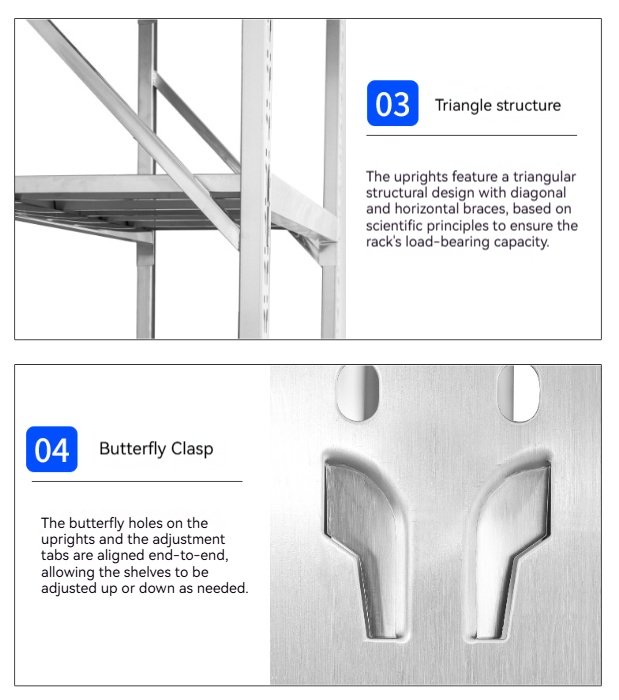
Laboratory Stainless Steel Storage Rack Specification Table
| Parameter | Standard | Options / Notes |
|---|---|---|
| Material | 304 Stainless Steel | 201 available for dry storage |
| Per-shelf capacity | 400kg | Also: 300kg, 500kg |
| Total capacity (4-tier) | 1,600kg | |
| Height | 2,000mm | Fixed |
| Width | 1,200 / 1,500 / 1,800 / 2,000mm | Per lab layout |
| Depth | 400 / 500 / 600mm | Per lab layout |
| Standard tiers | 4 | 3 or 5 on request |
| Height adjustment | 50mm increments | Butterfly snap, tool-free |
| Surface finish | Brushed, rounded edges | |
| Assembly | Butterfly snap, boltless | No through-holes |
| Packaging | KD | Moisture + corner + impact layer |
| Certification | CE | |
| Quote response | Within 24 hours |
CTA
Setting up a new lab or upgrading cleanroom shelving?
Contact us for a quote within 24 hours. Sample orders accepted. OEM available — logo printing, custom packaging, and custom manuals.