Carbon steel lockers in factory changing rooms rust through in three years. Not because they are poorly built — because a factory is a hostile environment for metal. Cutting oil sprays onto the cabinets. Chemical vapors hang in the air. Forklifts and trolleys scrape past the doors every shift, leaving dents that cannot be repaired. The floor gets hosed down daily, and moisture climbs up from the bottom. The base plates of metal lockers rot within a year.
Stainless steel costs triple and still suffers pitting corrosion under chemical exposure. Hit a stainless door with a pallet jack — dented, cannot be fixed, replacing one door costs more than a whole plastic locker unit. Wooden cabinets absorb oil and moisture until they swell and rot. Veneer-covered particle board peels at the edges within months, leaving workers with crumbling locker fronts.
ABS plastic lockers were not designed for an office. They were designed for this environment. Cutting oil and chemicals have no effect on the material. A forklift bump — the panel springs back, no dent. When the cabinet is dirty, you hose it down. Two workers pick it up and set it where it needs to go, without calling maintenance for a forklift. When the production line layout changes, the lockers move with it.
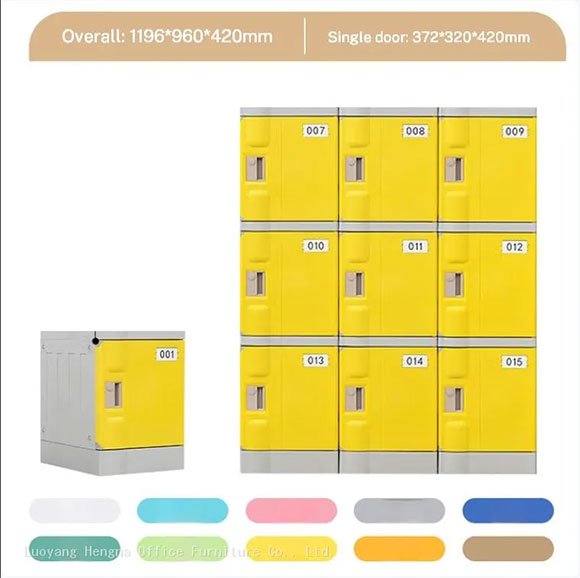
Corrosion-Resistant ABS Locker 1196x960x420mm for Factory Specifications
| Item | Specification |
|---|---|
| Overall dimensions | 1196mm(W) × 960mm(H) × 420mm(D) |
| Configuration | 9 doors (3 columns × 3 rows) |
| Single compartment | 372mm(H) × 320mm(W) × 420mm(D) |
| Fits | Work clothes, steel-toe boots, hard hat, lunch box |
| Base | 80mm raised molded base, moisture and flood barrier |
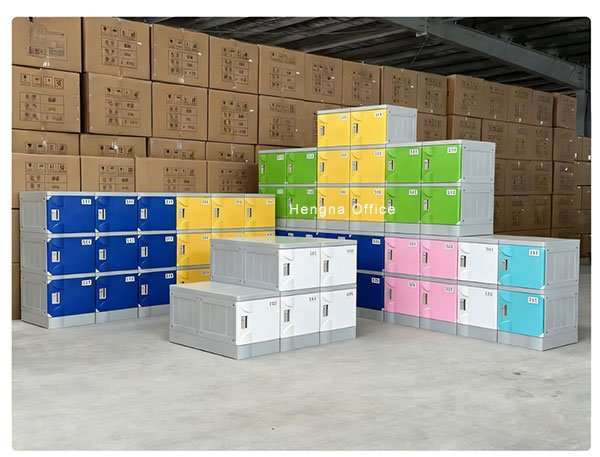
| Standard colors | Yellow, white, blue, pink, gray, green, orange, brown (8 colors) |
| Custom colors | Pantone matching (MOQ 10 units) |
| Locks | Mechanical key / Combination / RFID / Padlock hasp (mixable) |
| Assembly | Tool-free clip-and-lock, side-by-side and stackable |
| Certification | CE |
Installed Without Stopping Production
No screws, no glue. Two people with a rubber mallet assemble a 200-door changing room in one day. No welding, no painting, no weekend shutdown. Metal lockers require the changing room to close for days — ABS lockers arrive and are ready the next morning. The modular design expands sideways. When the factory adds a new shift and needs more lockers, place another unit directly beside the existing row.
Maintenance Is a Hose
Metal lockers need scrubbing when they get oily. Rust has to be ground down and touched up. Factory-grade grease leaves a film that a rag cannot fully remove. An ABS locker gets hosed down. Oil, grease, and chemical residue wash off together. The cabinet has no seams where moisture can collect — spray it and walk away.
The 80mm base keeps floor water and wash-down runoff out. Multiple shifts share the same locker, and a quick rinse between handovers keeps it clean. A decade later it still looks like the day it was installed.
Built for the Work Floor
A key hook inside each door — workers keep their assigned locker key on the hook, not in their pocket where it gets lost during a shift. A retractable hanging rod for coveralls, pushed up when not needed. A towel bar that lets wet towels air out instead of staying damp in a closed compartment.
The open top shelf holds hard hats and shared PPE — safety glasses, earplugs, inspection tools. Workers grab them on the way in, drop them on the way out. No need to take a hard hat home between shifts.
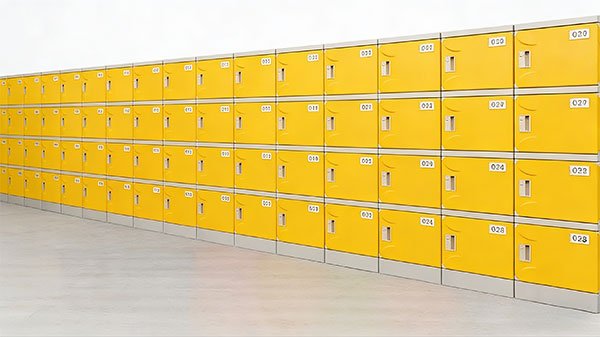
The number plate is molded into the door panel, cannot peel off. Maintenance knows at a glance which locker belongs to which worker. Every corner is rounded — in a narrow aisle with equipment moving around, nobody gets hurt bumping into them. Spring catches keep doors closed when unlocked.
Colors and Locks
The color runs through the material — not painted, not laminated. Factories use zone-based colors: orange for the maintenance bay, blue for quality control, gray for visitor lockers. Pantone matching for company-branded facilities.
One order covers four lock types. Production workers get mechanical keys. Shift supervisors get combination locks (no key to transfer between shifts). Plant managers use RFID cards. All four on the same batch of cabinets, one delivery.
How Many Do You Need
Factory changing rooms are calculated by shift. A single shift of 50 workers needs 6 units of 9-door cabinets. A three-shift operation needs 18 units. The footprint: approximately 3.2 by 2 meters for a single row. Narrow aisles are fine — the cabinets connect side-by-side without wasted space between units.
FAQ
| Question | Answer |
|---|---|
| MOQ | 1 unit (standard color + standard lock) |
| FOB | Inquire for current FOB pricing |
| Warranty | 1 year |
| Lead time | Regular stock available, depends on quantity and configuration |
| OEM/ODM | Silk-screen logo, custom color, custom lock mix, custom manual |
| Packaging | Each unit individually packed, suitable for sea freight |
About Outdoor Use
ABS performs well indoors and in covered outdoor areas. If the lockers are in direct sunlight, install them under a shaded structure or choose an indoor location. Any material changes under prolonged direct exposure.
For inquiries, please tell us your application, head count, preferred colors, and lock types. We will respond with a quote within 24 hours.
Frequently Asked Questions
What makes ABS lockers corrosion-resistant compared to steel lockers?
ABS plastic is inherently non-reactive to moisture, salt, and most industrial chemicals. Unlike steel lockers that rely on powder coating for corrosion protection, ABS lockers are molded from solid plastic throughout. When the coating on steel lockers gets scratched or chipped, the exposed metal begins rusting immediately. ABS lockers have no coating to damage — the entire structure is corrosion-proof.
Are ABS lockers suitable for chemical plant changing rooms?
Yes. ABS lockers resist exposure to most industrial chemicals including acids, alkalis, solvents, and oils. In chemical plants where workers’ clothing may be contaminated with chemical residues, ABS lockers won’t degrade or discolor. The smooth surface is also easy to clean — simply wipe with a damp cloth. For areas with heavy chemical exposure, we recommend the 9-door configuration with ventilation slots.
What is the load capacity of ABS locker doors and shelves?
Each ABS locker compartment supports 15kg of static load. The doors are reinforced with internal ribs and can withstand 50kg of force without cracking. For heavy-duty applications where workers store tools or equipment along with clothing, we recommend the 4-door or 6-door configurations which have larger compartments and reinforced shelving.
How do ABS lockers handle impact in factory environments?
ABS plastic has high impact resistance — it’s the same material used in automotive bumpers and safety helmets. In factory environments where lockers may be hit by carts, tools, or equipment, ABS dents and rebounds rather than cracking. The flexible nature of ABS absorbs impact energy. Steel lockers, by contrast, dent permanently and the powder coating cracks, exposing bare metal to corrosion.