You’re not buying a cupboard for a dry office. You’re putting it next to a swimming pool. Inside a commercial kitchen. In a beachfront hotel basement. Humidity above 90%, condensation running down the walls. Standard cabinets in these places die within six months.
This one is built for it. 304 stainless steel. Drain pan included. Corrosion-resistant. Door shut, moisture stays out. Door open, wet tools go in and don’t fester.
What wet areas do to standard cabinets
Swimming pool plant rooms. Chlorine off-gassing. Humidity at 95% year-round. Regular steel cabinets—door hinges seize in three months. 201 stainless does better, but after a year the weld points show rust. 304 is the only grade that survives 10+ years in that environment.
Beachfront hotels. Salt spray plus moisture doubles the corrosion rate compared to inland. Standard stainless cabinets show rust spots within 18 months. 304 contains molybdenum, which resists salt-spray corrosion far better than 201.
Commercial kitchens. Dishwasher steam. Standing water on the floor. Cleaning chemical splashes. Plastic cabinets warp. Wood absorbs moisture and swells. Steel cabinets rot at the base. 304 handles all of it.
For wet areas there are two options: 304 stainless, or plan on replacing cabinets every year. There is no third option.
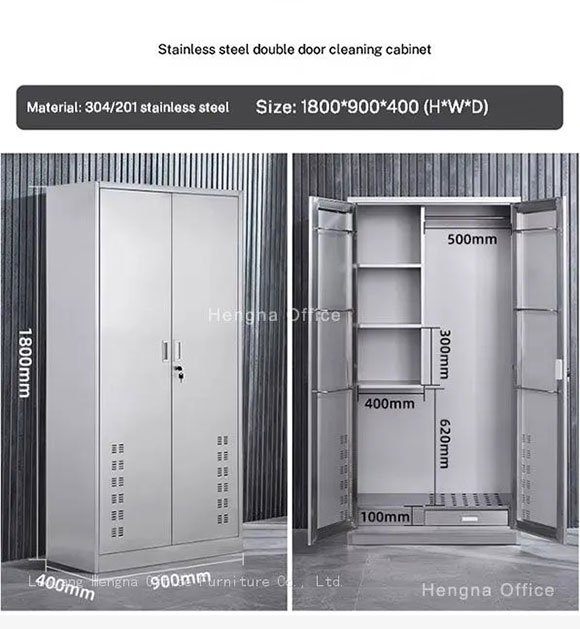
Janitorial Cupboard with Drain Pan Specs
| Item | Spec |
|---|---|
| Material | 304 stainless steel (molybdenum for chlorine/salt resistance) |
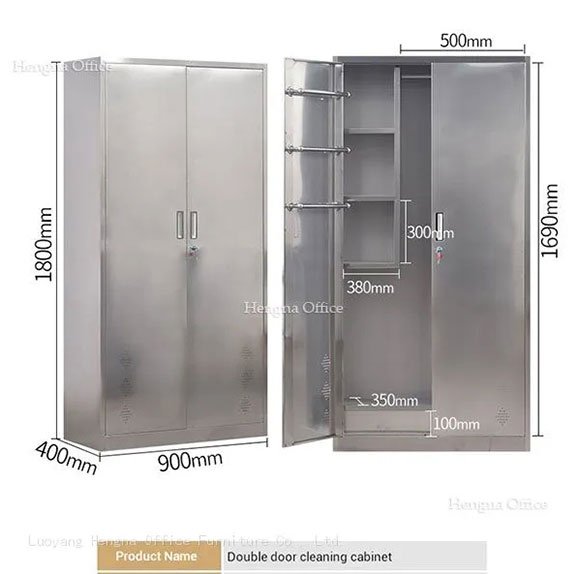
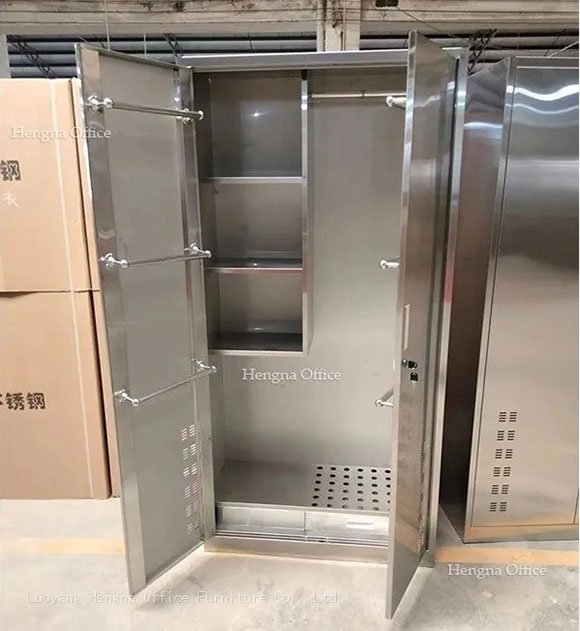
| Dimensions | W500 × D400 × H1800mm (with feet) / H1690mm (body) |
| Door | Double door, key lock |
| Shelf spacing (top to bottom) | 300 / 380 / 350 / 100mm |
| Drainage | Bottom drain hole + removable drain pan |
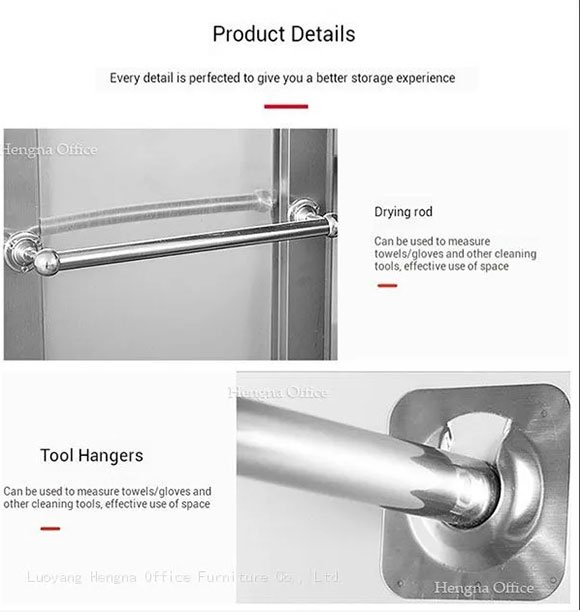
| Drying rod | Stainless steel bar |
| Hooks | Side panel hooks |
| Lock | Steel cylinder, anti-pry |
The real difference between 304 and 201
304 has two things 201 doesn’t: 8-10% nickel content, and molybdenum.
Nickel handles acid and alkali resistance. Molybdenum handles chloride ions—the chlorine in pool air, the salt in coastal spray, the cleaning agents in commercial kitchens. 201 has no molybdenum. Expose it to these and rust spots appear within a year or two.
Practical example: 201 in a standard wet environment lasts 8-10 years. Put it in a pool plant room, rust appears in two years. 304 in that same pool plant room goes 10+ years without rust.
A beachfront resort client in Dubai used 201 units in their pool equipment room. Within 18 months, rust spots covered the inside of the doors. They thought it was a manufacturing defect. We looked at the photos—salt spray and chlorine gas, 201 can’t handle it. Switched to 304. Three years, zero rust. The 201 wasn’t defective. The environment was too aggressive.
The drain pan—not optional in wet areas
In wet areas, water inside the cabinet isn’t an accident. It’s daily routine. A mop coming back from the pool deck drips chlorinated water. A kitchen mop carries detergent residue. A beach hotel mop collects salt-laden condensation.
That water sitting at the bottom of the cabinet will eventually compromise anything. Doesn’t matter what the walls are made of.
The drain hole at the base sends water straight to the removable pan. Housekeeping pulls it out at end of shift and empties it. The pan is 304 stainless, not plastic—because chlorinated water builds up residue in plastic that eventually smells.
A leisure centre client in the UK told us their old cabinet had no drain. Staff put a bucket underneath to catch water. Bucket overflowed when nobody emptied it, soaked the cabinet base. After switching to this model, the problem disappeared. “The drain pan matters more than the cupboard itself”—his words.
Where to use this cupboard
Swimming pools and aquatic centres. Chlorine off-gassing, extreme humidity. 201 stainless won’t last. 304 is the only sensible choice. Public pools in the UK and Australia specify 304 stainless cupboards as standard—it’s written into their procurement guidelines.
Beachfront hotels and resorts. Salt-spray corrosion is aggressive. Within 500 metres of the sea, 201 stainless shows rust spots in 18 months. 304 with molybdenum protection goes 3-5 years without issues.
Commercial kitchens and restaurant back-of-house. Dishwasher steam, cleaning chemicals, grease, standing water. Four corrosion sources hitting simultaneously. Standard materials fail within a year. 304 handles all four.
Food processing plants. High humidity, strong cleaning agents, hygiene standards demanding rust-free equipment. 304 is food-grade stainless, compliant with HACCP requirements.
Marinas and marine facilities. Direct seawater contact, salt-spray concentration even higher than beach hotels. 304 needs periodic washing to remove salt deposits, but won’t rust. 201 in this environment is scrap within six months.
Breweries and beverage plants. Acidic cleaners plus high humidity. 304’s acid resistance is significantly stronger than 201.
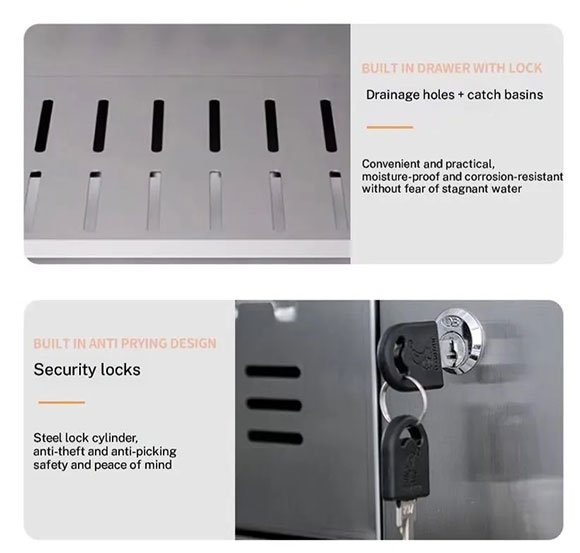
Lock—standard
Steel cylinder lock. Anti-pry. Key managed by the housekeeping supervisor.
In public facilities—pools, hotels, kitchens—cleaning chemicals and tools can’t be accessible to everyone.
Common questions
Q: Will 304 really not rust in a pool plant room? A: It won’t. 304 contains molybdenum specifically for chloride resistance. 10+ years of normal use with no rust. If salt deposits build up on the surface, wipe them down periodically—the salt layer itself attracts moisture and can affect appearance, not the steel underneath.
Q: How often should the drain pan be emptied? A: In wet areas, housekeeping should dump it at shift change. The 304 pan rinses clean with water, no residue buildup.
Q: Beach hotel within 500m of the sea—can 201 work? A: No. Salt-spray deposition typically extends 1-2 km inland. Within 500 metres, use 304. We’ve seen too many clients get this wrong at this distance, rust appearing in 18 months.
Q: What’s the difference between this and a standard stainless cupboard? A: Standard cupboards usually have no drainage—standing water is normal in wet areas. They typically use 201 stainless or plain steel, neither of which survive wet area conditions. This one is spec’d from material to drainage specifically for wet environments.
Q: Do you ship to the UK, Australia, and Middle East? A: Yes. We export regularly to these regions. Sea freight packaging includes moisture-proof wrapping. Arrives intact.
Q: Minimum order? A: Samples: 1 unit. Bulk pricing on request. Contact us for a quote with your quantity and destination.
About us
Luoyang Hengna Office Furniture Co., Ltd. 9 years in steel furniture. We noticed customers in the UK, Australia, and the Middle East search for “cupboard” rather than “cabinet”—different terms, same need: a wet-area cleaning cupboard built from 304 stainless.
We work directly with our production base. Products ship worldwide. CE certified. OEM available.
Need a quote? Send your quantity and shipping destination. Response within 24 hours.