In chemical plants, coatings factories, printing workshops, and other industrial facilities, flammable liquids such as solvents, coatings, and inks exist everywhere. They are essential raw materials for production—yet they also behave like “ticking time bombs” when stored improperly. Their high volatility and low flash point mean that even a single mistake can lead to fires, explosions, environmental contamination, or major financial losses.
A red 60-gallon flammable safety cabinet is not just another piece of equipment sitting in a workshop corner—it is a critical safety barrier that protects employees, assets, and your entire operation. For companies that handle flammable materials daily, investing in a compliant safety cabinet is not optional. It is a non-negotiable requirement for safe, legal, and sustainable operations.
Recognizing the Hazard: The True Risks Behind Flammable Liquids
Common Flammable Liquids in Industrial Facilities
Flammable liquids appear in many forms—from large solvent drums to small laboratory reagent bottles. In typical production environments, you may encounter:
- Inks: Solvent-based inks widely used in printing contain large amounts of organic solvents.
- Coatings: Industrial coatings, thinners, and curing agents often have flash points below 25°C.
- Colorants: Many synthetic dyes rely on highly volatile solvent carriers.
These materials are indispensable—but extremely dangerous without proper containment.
The Severe Risks You May Underestimate
The hazards associated with flammable liquids are often greater than facility managers realize. Key threats include:
- Fire & Explosion: Vapors can ignite instantly when exposed to static electricity, welding sparks, or open flames. In confined spaces, the blast force can be catastrophic.
- Health Risks: Extended exposure to solvent vapors may cause headaches, respiratory issues, organ damage, or even cancer (e.g., benzene-based solvents).
- Environmental Damage: Spilled chemicals can seep into soil and groundwater, requiring costly remediation.
The Cost of Improper Storage
Storing flammable liquids on normal shelves or in open corners is equivalent to planting explosives in your facility:
- In 2019, a chemical plant explosion caused by improperly stored solvent drums resulted in three deaths and millions in damages.
- In 2022, a printing facility lost over $200,000 in penalties and downtime because an ink spill halted production for an entire week.
The conclusion is clear: professional storage is not optional—it’s urgent.
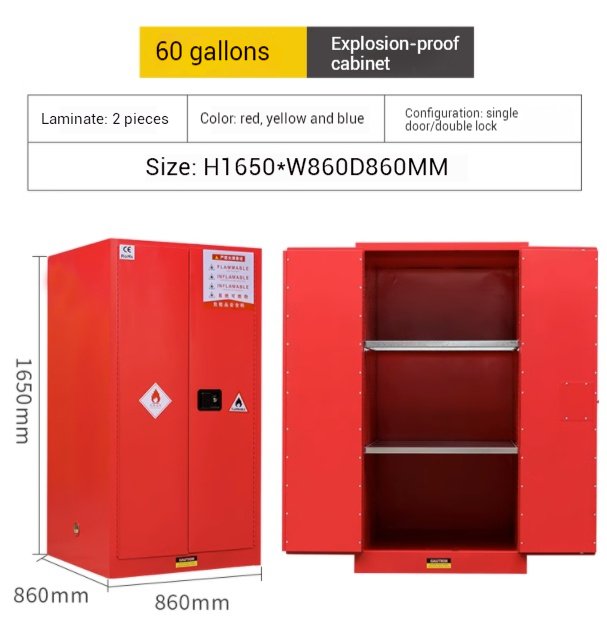
Red 60-Gallon Flammable Cabinets: The Expert Solution for Risk Control
Why Red? The Universally Recognized Warning Color
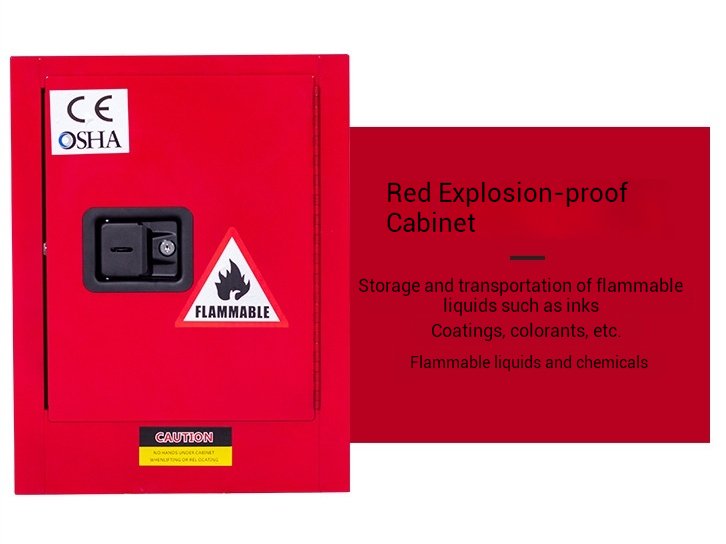
Red is globally recognized as the standard color for flammable materials. It complies with OSHA and NFPA guidelines and acts as an immediate visual warning. Employees know instantly:
“This cabinet contains hazardous materials—handle with caution.”
This visual cue alone significantly reduces operational mistakes and enforces safer behavior in the workplace.
Why 60 Gallons? The “Goldilocks Capacity” for Most Facilities
The 60-gallon capacity is considered the ideal size for chemical plants and manufacturing workshops:
- Stores 10–15 units of 5-gallon containers, perfect for daily operations
- Works well as a dedicated storage point in large facilities
- Large enough for bulk inventory, yet small enough to move or reposition during layout changes
It balances storage efficiency, footprint, and operational convenience.
Core Value of a Safety Cabinet: Controlled Isolation of Hazardous Liquids
Multi-Layer Safety: A Physical Barrier That Breaks the Accident Chain
A compliant flammable cabinet is engineered to prevent fires from spreading and to contain internal hazards:
- Double-Wall Steel Construction: Two layers of cold-rolled steel plus a fire-resistant air gap dramatically slow heat transfer.
- Explosion-Proof Doors: High-temperature seals limit flame spread even if internal ignition occurs.
- Vent Ports: Allow integration with facility exhaust systems, reducing vapor accumulation to safe levels.
This multi-layer design ensures that even if something goes wrong inside the cabinet, the danger stays contained.
Features That Make the 60-Gallon Cabinet Truly Indispensable
🔒 Fire Protection & Dual-Lock Security
- Fire Rating: Built with 1.2 mm steel and fire-resistant insulation capable of withstanding temperatures up to 1200°C (EN 14470-1 compliant).
- Dual-Lock System: Mechanical key lock + optional digital/biometric lock ensures strict access control and accountability.
🛡 Leak-Proof Sump & Adjustable Shelves for Versatile Storage
- Leak-Containment Sump: A built-in 1.5-inch deep PP spill sump holds accidental leakage without contaminating floors or drains.
- Adjustable Shelves: Shelves can be positioned to accommodate tall solvent drums or smaller lab containers, increasing storage efficiency by up to 40%.
💨 Mandatory Vent Ports for VOC Control
Facilities storing highly volatile solvents (e.g., acetone, ethyl acetate) must comply with OSHA 1910.106 guidelines. Connecting the cabinet’s 2-inch vent ports to your exhaust system ensures 24/7 ventilation and keeps VOC levels below TLV thresholds.
🏗 Built for Harsh Industrial Environments
- Galvanized cold-rolled steel with ≥60μm powder coating
- Corrosion-resistant surfaces withstand acids, alkalis, and humidity
- High-durability hinges rated for 100,000+ open/close cycles
- Reinforced base corners protect against forklift and pallet jack damage
This is an industrial-grade product built for long-term reliability.
Why Buying a Professional Cabinet Is a Long-Term ROI Investment
1. Protecting Employees: Your Most Valuable Asset
Studies show that over 80% of chemical accidents are linked to improper storage. A compliant flammable cabinet reduces the risk of ignition by over 90%.
2. Reducing Financial Losses & Avoiding Production Downtime
A single chemical fire can cost hundreds of thousands in equipment damage, lost inventory, and halted operations. A $300–$600 cabinet is negligible compared to potential losses.
3. Strengthening Safety Culture & Corporate Image
Customers in automotive, electronics, aerospace, and pharmaceutical industries increasingly demand safety compliance from suppliers. A proper flammable storage system signals professionalism and operational maturity.
Frequently Asked Questions (FAQ)
Q1: How many containers can a 60-gallon cabinet store?
A 60-gallon model typically holds 12–15 five-gallon containers or 200–250 one-liter bottles. Do not exceed 80% of total capacity to ensure ventilation.
Q2: Is connecting the vent ports mandatory?
For high-volatility liquids—yes. OSHA requires proper ventilation. For low-volatility liquids, you may not need mechanical ventilation but must monitor vapor levels regularly.
Q3: Can the cabinet be used outdoors?
Not recommended. Outdoor placement requires overhead protection and floor anchoring. Temperature fluctuations may also affect chemical stability.
Q4: Are other colors or sizes available?
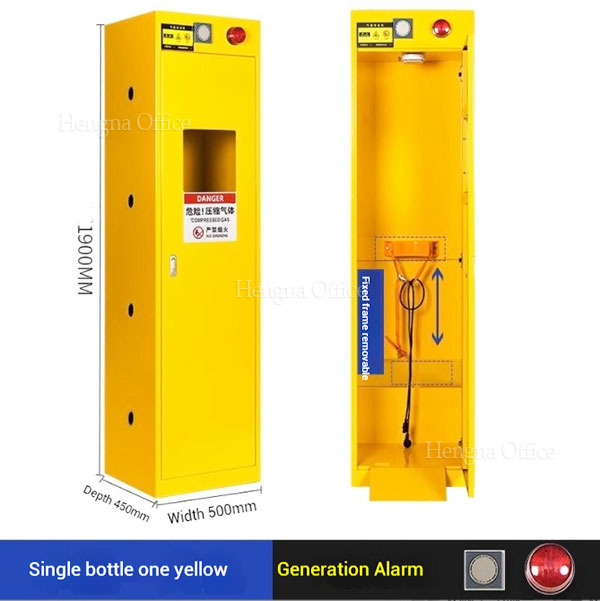
Yes. Yellow for corrosive liquids, blue for acids/alkalis, plus custom sizes such as 30/90 gallons. OEM/ODM branding and smart-lock upgrades are available.
Strengthen Your Safety Defense Today
In chemical plants and manufacturing facilities, safety is not a matter of chance—it is a matter of design.
The red 60-gallon flammable cabinet offers the perfect combination of compliance, capacity, durability, and performance. It is more than a storage solution—it is a crucial shield that protects your employees, assets, and long-term operational success.
Take action now. Build a safer, more compliant, and more resilient facility—starting with proper flammable liquid storage.